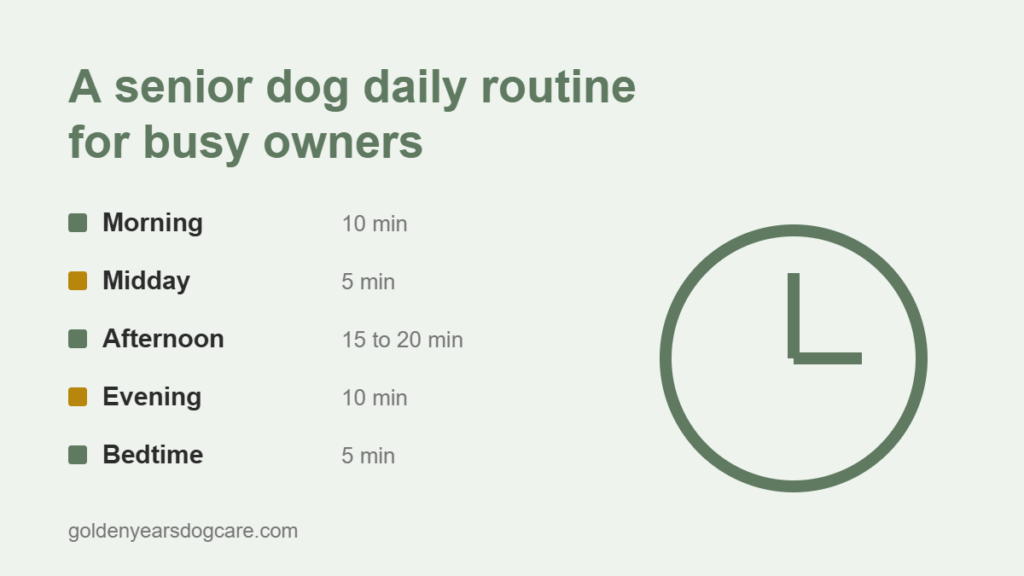
A senior dog does better on a routine than a young dog does, and so does the person looking after one. Not because older dogs are fragile, but because the things that go wrong in old age (a skipped meal, a missed pill, a stiff morning that turns into a week of limping) are easy to miss when every day is slightly different. This is the routine that works in most homes with a busy owner, laid out as morning, midday, evening and bedtime, with the two minutes of checking that make the rest of it worthwhile.
If you would rather have it on paper, the same routine is the daily column of our free senior dog care checklist, one sheet, seven checkboxes per line, made for the fridge door.
Morning (10 minutes)
Let the dog get up on its own time. Old joints are stiffest first thing. Give a minute before the walk, and watch the first few steps. Stiff for a minute then fine is normal aging. Stiff for the whole walk, or worse than yesterday, goes on the symptom tracker.
Bathroom trip, then breakfast. Same order every day so the dog knows what comes next. Note whether the dog ate all of it. Skipping breakfast once is nothing; skipping two meals in a row is a call to the vet.
Morning medications with food. Give them from the AM compartment of a pill organizer, then tick the medication chart. The tick is the whole point. It is what lets a partner or a sitter know the dose happened without asking.
Fresh water in every bowl. Older dogs often drink more, and a bowl that runs dry mid-morning is a missed signal. If the dog seems to be drinking far more than it used to, that goes on the tracker too.
Midday (5 minutes, or a note for whoever is home)
A short bathroom break. Many senior dogs cannot hold it from breakfast to dinner anymore. A midday trip out, or a dog walker for that one visit, prevents most indoor accidents. If nobody can be home, a washable pad by the door is a fair compromise.
Check the resting spot. Not too warm, not in a draft, and easy to get out of. A dog that has moved off its bed onto the cold floor is often telling you the bed is too hot or too hard to climb into.
Late afternoon (15 to 20 minutes)
The main walk, kept short and level. For most senior dogs, two short walks beat one long one. Choose flat routes, avoid hot pavement in summer, and let the dog set the pace. The walk is exercise, but it is also your daily look at how the dog moves.
Two minutes of hands on. While the dog is relaxed afterwards, run your hands over the whole body: ears, neck, chest, belly, legs, paws, tail. You are feeling for new lumps, sore spots, heat, and anything the dog flinches at. You are not diagnosing anything. You are noticing changes so the vet can.
Evening (10 minutes)
Dinner, then evening medications. PM compartment, tick the chart. If the dog needs a pill hidden in food, keep a jar of pill pockets or a spoon of something soft next to the organizer so it never becomes a chase.
Gentle movement after dinner. A slow lap of the garden or the block helps digestion and eases the evening stiffness. Skip it if the dog is clearly tired.
Write one line. Good day or hard day, and why. Ate, walked, any accidents, anything new. One line a day on the symptom tracker is more useful at the next vet visit than an hour of trying to remember.
Bedtime (5 minutes)
Last bathroom trip. As late as you reasonably can. Older dogs that have accidents overnight usually just needed one more trip out.
Set up the night. Water bowl within reach of the bed, a dim night light on the route to the door, a gate across the stairs if the dog wanders. Dogs that pace or seem confused at night often settle faster with a light on and the same bedtime every night.
Once a week, on top of the daily routine
Weigh the dog on the same scale at the same time and write it on the weight log. Refill the pill organizer and count what is left in the bottles. Check nails, paw pads and ears. Update the sitter sheet if anything about the routine changed. That is the whole weekly list, and it takes about fifteen minutes.
When the routine tells you something
The routine is not really about the walks and the meals. It is about the fact that when every day looks the same, the day that looks different stands out. Two skipped meals, a dog that cannot get up, drinking or peeing far more than usual, breathing fast while resting, a new lump, or confusion that is getting worse: those are the days to call the clinic, and the tracker and the weight log are what you bring with you.
All of these sheets, plus the medication chart, sitter instructions, vet visit prep pages and emergency cards, are collected in the Senior Dog Care Binder if you want them as one printable set.
This routine is an organizational guide, not veterinary advice. Your vet’s instructions for your dog always come first.