As an Amazon Associate, Golden Years Dog Care earns from qualifying purchases. This post contains a few Amazon affiliate links.
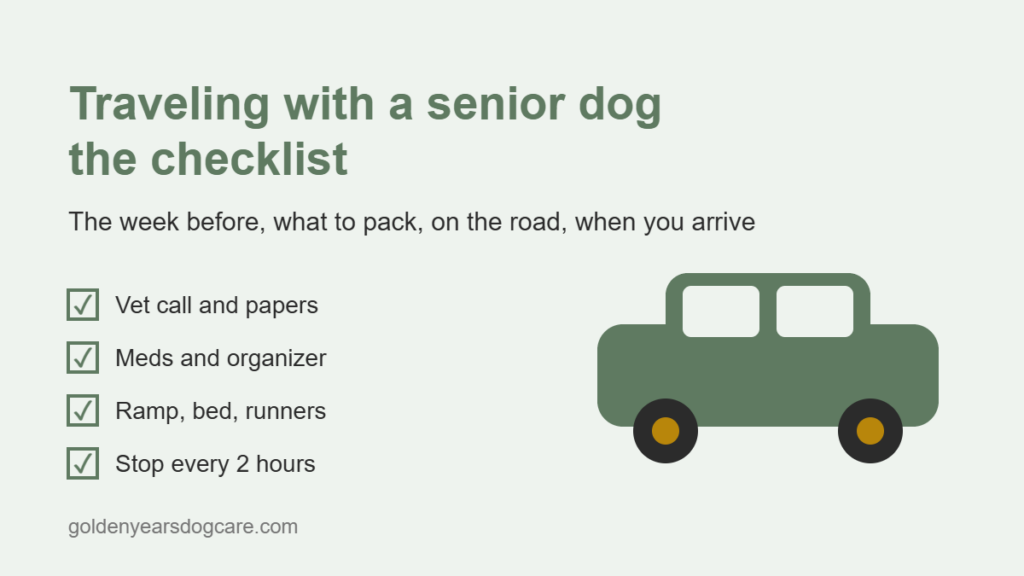
Taking an older dog on a trip is mostly a packing and paperwork problem, and both are solvable the week before. This checklist is for road trips and stays away from home with the dog along, split into what to sort out beforehand, what to pack, and what to do on the day. Flying is a separate subject and for most senior dogs the honest answer is not to.
The week before
Call the vet. Ask whether this dog is fit for the trip, whether any medication timing needs adjusting for a long drive, and for a printed copy of the medication list and vaccination record. If you are crossing a state line, ask whether a health certificate is needed. Get enough medication to cover the trip plus a week, in original bottles.
Find the emergency clinic at the destination. Name, address, phone, hours. Write it on the emergency contact sheet under the second clinic line. Do the same for anywhere you will stop overnight on the way.
Check the accommodation for stairs and floors. Ask for a ground floor room. Ask if the floors are tile or hardwood, and pack runners if they are. Ask where the nearest patch of grass is, because 2 am matters.
Do a short practice drive. An hour, with the ramp, the bed in the car and a stop halfway. It shows you whether the dog settles, whether it needs a harness or a crate to feel secure, and whether car sickness is going to be a thing.
What to pack
Paperwork, in one folder: medication list and chart, vaccination record, health certificate if needed, the emergency contact sheet with the destination clinic filled in, a copy of the sitter sheet in case someone else ends up minding the dog for an afternoon, and photos of the dog on your phone.
Medications: original bottles plus a pre-filled pill organizer for the trip days, pill pockets, oral syringes for liquids, and a small cooler bag if anything needs to stay cold.
Food and water: the dog’s usual food, measured into daily bags, plus a few extra. Water from home for the first day or two if your dog has a sensitive stomach. Collapsible bowls, and a spill proof bowl for the car.
Comfort and mobility: the dog’s own bed or at least its blanket, a folding ramp for the car, the support harness, non slip runners or a yoga mat for slippery floors, a night light, and a towel for muddy paws. A crash tested harness or a secured crate for the car itself.
See folding dog ramps for cars on Amazon
See crash tested car harnesses on Amazon
Clean up: waterproof pads for the car seat and the hotel bed, belly bands or diapers if the dog uses them, poop bags, wipes, an enzyme cleaner, and a spare lead.
The small things people forget: the tag with your mobile number, a printed photo of the dog, a torch for night walks, a second copy of the medication list in the glovebox, and the dog’s favourite toy.
On the road
Stop every two hours. Ten minutes of slow walking and a drink. Older dogs get stiff in the car the same way people do, and a dog that has been lying for four hours may struggle to get up.
Keep medication times. Set phone alarms for dose times and tick the chart when the dose is given, even in the car. Travel days are when doses get missed.
Never leave the dog in the car. Not for five minutes, not with the windows cracked. Older dogs handle heat worse than young ones. Plan food stops around drive-throughs or take turns.
Watch for the quiet signs. Panting at rest, refusing water, drooling, restlessness. Any of those means a longer stop in the shade and, if it does not settle, the nearest clinic on your list.
When you arrive
Set up the dog’s corner first: bed, water, runner across the slippery floor, night light on the route to the door. Walk the dog to the grass so it knows where it is. Keep the first evening quiet. Keep the routine, especially meal and medication times, as close to home as you can; the dog does not know it is on holiday, it only knows whether the day feels normal.
A note on flying
Cargo travel is hard on any dog and harder on an old one; many airlines will not take senior dogs in the hold, and many vets advise against it. In-cabin travel is possible for small dogs, with a vet certificate and a carrier the dog is used to. If the trip is optional, a good in-home sitter is usually the kinder choice. Boarding vs pet sitter covers how to choose.
The sheets mentioned here are free on this site, and all of them are in the Senior Dog Care Binder if you want them in one printable set to take with you.
This is an organizational checklist, not veterinary advice. Ask your vet before any long trip with an older dog.