Maybe your vet mentioned it at the last checkup. Maybe you looked at your dog’s gray muzzle and did the math. Either way, the word “senior” has come up, and you are wondering what it actually changes.
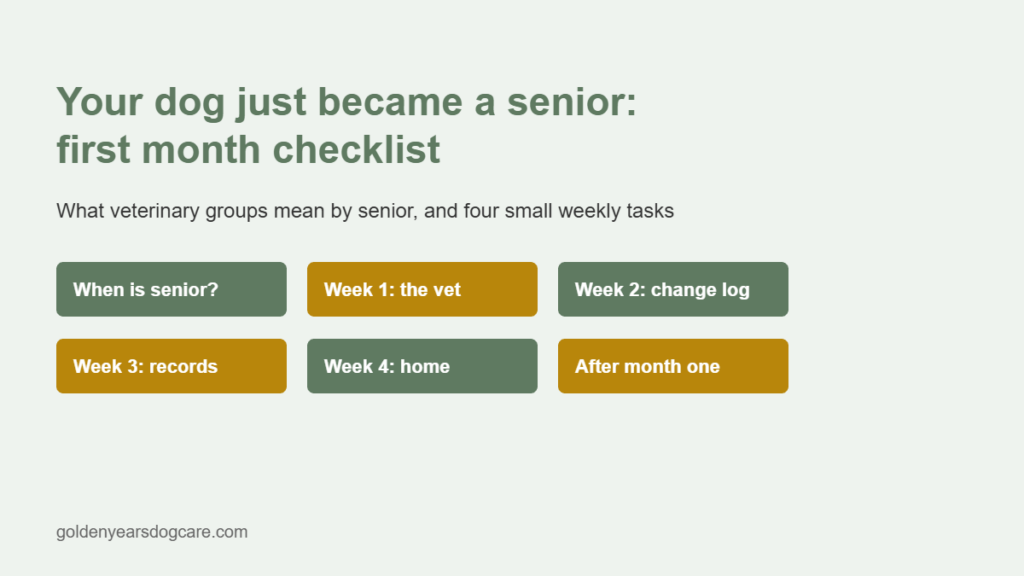
This page covers two things: what veterinary groups mean by a senior dog, and a simple checklist for the first month so you feel organized instead of worried. It is an organization guide, not veterinary advice. Your veterinarian is the right person to tell you where your own dog is in life and what care they need.
What age is a dog considered a senior?
There is no single birthday. The American Animal Hospital Association (AAHA) describes a senior pet as one in roughly the last 25% of its expected life span. Because small dogs tend to live longer than large dogs, the age changes with size.
Three well known sources give slightly different ranges:
- AAHA: smaller dogs may not be considered seniors until around 12, while large breeds can reach senior status as early as 7 to 8
- The American Veterinary Medical Association (AVMA): roughly 8 to 11 for small breeds, 8 to 10 for medium, 8 to 9 for large and 6 to 7 for giant breeds
- The American Kennel Club (AKC): large breeds may be seniors around 6, while small breeds may not reach senior status until 7 to 10
The ranges do not line up exactly, and that is the point: size, breed and health all play a part. Ask your vet whether they consider your dog a senior, and write the answer down. For more detail, see when is a dog a senior, or get a rough human age from our dog age calculator.
What changes when your dog becomes a senior
The biggest change is how often your vet wants to see your dog. The AVMA says senior pets need to see a veterinarian twice a year or more, and that senior exams tend to be more in depth. AAHA says the same in different words: senior pets need more frequent exams than younger pets. Our guide to how often a senior dog should see the vet goes into the details.
The second change is what you watch for at home. AVMA, AAHA and AKC all list changes owners should notice and report, such as stiffness or trouble with stairs, changes in sleep or behavior, changes in weight, and changes in sight or hearing. You do not need to judge what any of it means. Your job is to notice and write it down so your vet has the full picture. See changes in older dogs to write down for your vet.
Your first month checklist
Spread this over four weeks. One small task a week is enough.
Week 1: talk to the vet
- Call your clinic and ask how often they want to see your dog now. Put the next visit on the calendar.
- Ask what they would like you to watch for at home, given your dog’s breed and health.
- Ask whether any routine tests are due. Write down what they say rather than relying on memory.
Our list of questions to ask the vet about a senior dog is a good script for that call or visit.
Week 2: start a simple change log
Small changes are easy to miss and hard to remember at an appointment. Pick one place, a notebook or a printed sheet, and add a few lines each week:
- Walks: length, pace, any stiffness
- Stairs, getting into the car, getting up from bed
- Appetite and water
- Sleep, including restlessness at night
- Weight, if your vet has asked you to track it
- Anything new: a lump, a habit, a reaction
Our dog symptom tracker and dog weight and breathing log give you ready made layouts.
Week 3: put medications and records in one place
- Copy every medication and supplement onto one list, exactly as written on the label. Our printable dog medication chart works well for this.
- Gather vaccine records, recent visit notes and your clinic’s and nearest emergency clinic’s phone numbers.
- Fill in an emergency contact sheet and keep it where a family member or sitter can find it.
Week 4: make home and handoffs easier
AAHA and AVMA both suggest simple home changes for older pets, such as non slip rugs, an orthopedic bed, and ramps or pet stairs where jumping has become hard. AVMA also advises not rearranging furniture if your dog’s eyesight is fading, since familiar layouts are easier to get around.
- Walk through your home and note anywhere your dog slips, hesitates or struggles
- Write your dog’s routine down: meals, medications, walks, bedtime
- Update your notes for anyone who cares for your dog. Our senior dog pet sitter instructions template makes this quick
After the first month
Keep it light. A few minutes a week on the change log, a quick look at the medication list whenever something changes, and a fresh copy of your notes before each vet visit. Our senior dog care checklist covers the ongoing routine.
If you notice something that worries you between visits, call your vet. A written log makes that call easier, because you can say when it started and how often it happens.
Keep it all in one place
The printable Senior Dog Care Binder ($15) brings vet visit notes, medication pages, logs and caregiver handoff pages together in one folder, so the senior years are easier to keep track of. If you want one page to start with today, get the free emergency and medication card and keep it on the fridge.
Sources
- American Animal Hospital Association (AAHA), “Senior status: Understanding your senior pet’s life stage”: https://www.aaha.org/resources/senior-status-understanding-your-senior-pets-life-stage/
- American Veterinary Medical Association (AVMA), “Caring for senior cats and dogs”: https://www.avma.org/resources-tools/pet-owners/petcare/senior-pets
- American Kennel Club (AKC), “Signs of Aging in Dogs: Physical, Mental, and Behavioral Changes to Watch For”: https://www.akc.org/expert-advice/health/aging-in-dogs-physical-mental-signs/
Golden Years Dog Care provides organizational tools and checklists, not veterinary advice. Always follow your veterinarian’s instructions for your dog’s medications and conditions.