Your dog just turned 10. Maybe you saw a birthday post, maybe a vet reminder, and now you are wondering what that number really means. Is a 10 year old dog old? How old is that in people years?
This page walks through the two methods you will see most often, explains why they give different answers, and turns the number into a few practical steps. It is an organization guide, not veterinary advice. Your veterinarian is the best person to tell you where your own dog is in life.
The short answer
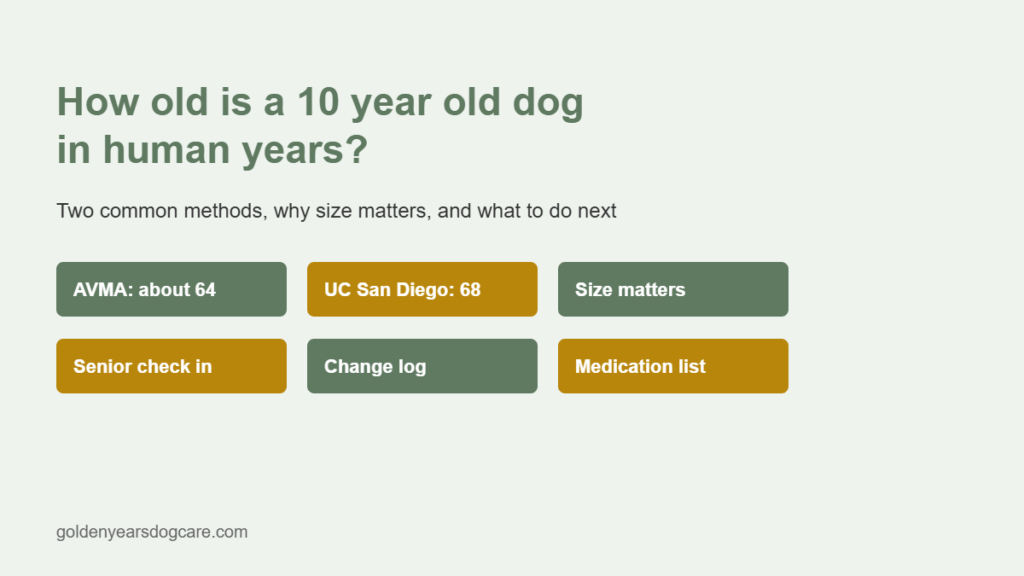
Using the rule of thumb the American Veterinary Medical Association (AVMA) gives for a medium sized dog, a 10 year old dog is about 64 in human years. A 2019 study from UC San Diego, which used a different method, puts a 10 year old Labrador at about 68. Either way, a 10 year old dog is in the later part of life, and most dogs are treated as seniors well before this age.
Method 1: the AVMA rule of thumb
The American Kennel Club (AKC) explains the AVMA’s guideline for a medium sized dog this way:
- The first year equals about 15 human years
- The second year adds about 9 more, for about 24
- Each year after that adds about 5
So for a 10 year old medium sized dog: 15 + 9 = 24 for the first two years, then 8 more years at 5 each, which adds 40. That gives about 64.
The old “multiply by 7” rule is not accurate. By that rule a 10 year old dog would be 70, which overstates the later years and understates how fast puppies grow up.
Method 2: the UC San Diego study
In 2019, researchers in Trey Ideker’s lab at the UC San Diego School of Medicine compared age related chemical changes in DNA in 104 Labrador Retrievers with the same changes in people. As reported by AKC and EarthSky, they proposed this formula:
Human age = 16 times the natural logarithm of the dog’s age, plus 31
For a 10 year old dog, that works out to about 68. The study looked only at Labradors, so it may not fit small or giant breeds well. Treat it as an interesting estimate, not a rule.
Why size matters
Both AKC and the American Animal Hospital Association (AAHA) point out that size changes the picture. AKC notes that larger breeds tend to have shorter lifespans. AAHA describes a senior pet as one in roughly the last 25% of its expected life span, and says smaller dogs may not be considered seniors until around 12, while large dogs can reach senior status as early as 7 to 8.
In practice that means:
- A 10 year old small dog may be just reaching the senior stage
- A 10 year old medium dog is usually a senior
- A 10 year old large or giant dog has usually been a senior for a few years
If you want a quick number for your own dog, try our dog age calculator, and see when is a dog a senior for more on size and life stage.
What the number changes in day to day care
The exact human age matters less than what you do with it. AAHA says senior pets need more frequent veterinary exams than younger pets, and that owners should watch for and mention changes in behavior, mobility, senses and routine. Here is how to get organized around that.
1. Book a senior check in
- Ask your clinic how often they would like to see your dog at this age. Our guide to how often a senior dog should see the vet explains what veterinary groups recommend
- Put the next visit on your calendar before you leave
- Bring a written list of questions. Our questions to ask the vet about a senior dog is a good starting point
2. Start a simple change log
Small changes are easy to miss and hard to remember at the vet. A few lines a week are enough:
- Walks: shorter, slower or the same
- Stairs, jumping into the car, getting up from bed
- Appetite and water
- Sleep, including any restlessness at night
- Anything that seems new: a habit, a reaction, a lump you noticed
Our dog symptom tracker has a ready made layout.
3. Write down every medication and supplement
If your dog takes anything regularly, copy it from the label onto one list, exactly as written. Our printable dog medication chart keeps doses and times in one place for everyone in the house.
4. Update your handoff notes
If a sitter, walker, boarding facility or family member ever cares for your dog, make sure their notes reflect your dog as they are now, not as they were at five. See our senior dog pet sitter instructions.
What about 12, 14 or 16?
Using the same AVMA rule of thumb for a medium sized dog, each extra year adds about 5 human years: about 74 at 12, about 84 at 14 and about 94 at 16. We cover how old a 12 year old dog is in human years in more detail.
Keep it all in one place
The printable Senior Dog Care Binder ($15) gathers vet visit notes, medication pages, logs and caregiver handoff pages in one folder, which makes the senior years far easier to keep track of. If you want one page to start with today, get the free emergency and medication card and keep it on the fridge.
Sources
- American Kennel Club (AKC), “How to Calculate Dog Years to Human Years” (cites the AVMA guideline and the UC San Diego study): https://www.akc.org/expert-advice/health/how-to-calculate-dog-years-to-human-years/
- EarthSky, “A better way to convert dog years to human years” (UC San Diego, Ideker lab, 2019): https://earthsky.org/human-world/a-better-way-to-convert-dog-years-to-human-years/
- American Animal Hospital Association (AAHA), “Senior status: Understanding your senior pet’s life stage”: https://www.aaha.org/resources/senior-status-understanding-your-senior-pets-life-stage/
Golden Years Dog Care provides organizational tools and checklists, not veterinary advice. Always follow your veterinarian’s instructions for your dog’s medications and conditions.